These are the individual properties that a WRK model can feature, grouped by the benefit they provide to the user. They are combined with each other to form the SB–S7 and OB–O7 levels shown below.
Structural protection
P
Penetration resistance
The sole features a metallic midsole that prevents nails or sharp objects from penetrating from the ground.
PL
Non-metallic penetration resistance
Same protection as P, with a non-metallic midsole: lighter and without interfering with metal detectors.
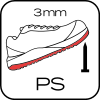
PS
Non-metallic penetration resistance (PS type)
Non-metallic variant of penetration resistance, with a different requirement level than the PL type.
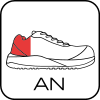
AN
Ankle protection
Reinforcement in the collar that protects the ankle against bumps, sprains, or lateral impacts.
MF
Metal Free
Without metallic components: does not interfere with metal detectors or security gates (airports, industrial plants).
Reinforcement over the instep that protects the metatarsal bones against impacts or falling heavy objects.
AN
Ankle protection
Reinforcement in the collar that protects the ankle against bumps, sprains, or lateral impacts.
CR
Cut resistance
The upper material resists accidental cuts from tools or sharp objects.
MF
Metal Free
Without metallic components: does not interfere with metal detectors or security gates (airports, industrial plants).
Resistance and grip
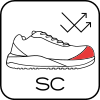
SC
Scuff cap abrasion resistance
The toe cap resists rubbing and repeated wear without opening or deteriorating.
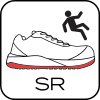
SR
Slip resistance
Certified grip on ceramic tile with glycerin: ideal for kitchens, cleaning, and slippery floors.
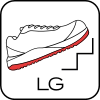
LG
Ladder grip
Sole designed for climbing and descending ladders and inclined surfaces safely.
FO
Resistance to fuel oil
The sole does not degrade in contact with oils, greases, or fuels.
WPA
Water penetration and absorption
The upper of the shoe limits the amount of water that enters and that the material absorbs.
HRO
Resistance to hot contact
The sole withstands direct contact with hot surfaces without deforming or melting.
Comfort, climate, and electricity
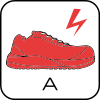
A
Antistatic footwear
Dissipates static electricity accumulated in the body, reducing the risk of sparks and discharges.
ESD
Controlled electrostatic dissipation
Stricter electrical resistance range than “antistatic”: protects sensitive electronic components and environments with explosion risks.
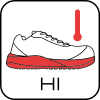
HI
Heat insulation of the sole complex
Protects the foot from heat rising from the ground in high-temperature environments.
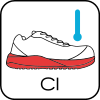
CI
Cold insulation of the sole complex
Protects the foot from the cold ground in cold storage rooms or frozen outdoor areas.
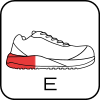
E
Energy absorption in the heel
The heel cushions the impact when walking, reducing fatigue during long days on your feet.
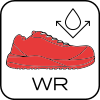
WR
Water resistance
The entire shoe—not just the sole—resists water and keeps the foot dry.
Combined levels
Structural protection properties are grouped into cumulative levels: each level includes everything from the previous one and adds something more. Compare the family with toe cap (S) and without toe cap (O).
1
SB
entry level
Covers the basic requirements for safety footwear with a protective toe cap.
2
S1
adds to SB
Closed heel area
Energy absorption in the heel (E)
Antistatic (A)
3
SP · S1PL · S1PS
adds to S1
Penetration resistance, depending on the type of midsole (P, PL, or PS)
4
S2
adds to S1
Water penetration and absorption (WPA)
5
S3 · S3L · S3S
adds to S2
Penetration resistance, depending on the type
Cleated outsole
6
S7 · S7L · S7S
adds to S3
Water resistance of the whole shoe (WR)
1
OB
entry level
Covers the basic requirements for occupational footwear, without a protective toe cap.
2
O1
adds to OB
Closed heel area
Energy absorption in the heel (E)
Antistatic (A)
3
O1P · O1PL · O1PS
adds to O1
Penetration resistance, depending on the type of midsole (P, PL, or PS)
4
02
adds to O1
Water penetration and absorption (WPA)
5
O3 · O3L · O3S
adds to O2
Penetration resistance, depending on the type
Cleated outsole
6
O6
adds to O2
Water resistance of the whole shoe (WR)
7
O7 · O7L · O7S
adds to O3
Water resistance of the whole shoe (WR)
Don't know which level your team needs?
Tell us about the work environment—construction site, warehouse, kitchen, cold storage, clean room—and we will tell you which combination of properties and WRK model fits.
Usamos cookies para que la web funcione y, con tu permiso, para recordar tus preferencias, medir el uso de la web y personalizar comunicaciones.
Funcional
Always active
El almacenamiento o acceso técnico es estrictamente necesario para el propósito legítimo de permitir el uso de un servicio específico explícitamente solicitado por el abonado o usuario, o con el único propósito de llevar a cabo la transmisión de una comunicación a través de una red de comunicaciones electrónicas.
Preferencias
El almacenamiento o acceso técnico es necesario para la finalidad legítima de almacenar preferencias no solicitadas por el abonado o usuario.
Estadísticas
El almacenamiento o acceso técnico que es utilizado exclusivamente con fines estadísticos.El almacenamiento o acceso técnico que se utiliza exclusivamente con fines estadísticos anónimos. Sin un requerimiento, el cumplimiento voluntario por parte de tu proveedor de servicios de Internet, o los registros adicionales de un tercero, la información almacenada o recuperada sólo para este propósito no se puede utilizar para identificarte.
Marketing
El almacenamiento o acceso técnico es necesario para crear perfiles de usuario para enviar publicidad, o para rastrear al usuario en una web o en varias web con fines de marketing similares.